
Pls kindly find what we can do for you.
|
Choose The Right Surface Roughness For CNC Parts?CNC machining is a highly precise and precise manufacturing process that can create parts with tolerances as small as 0.025 mm. Since it is a subtractive manufacturing method, it is inevitable that fine cut marks will be left on the surface of the finished product during the processing of the part, which leads to the roughness of the surface to a certain extent. 1. What is Surface Roughness? Surface roughness is a measurement of the average texture of the surface of a part, which in this case refers to the surface roughness after CNC machining. There are different parameters used to define surface roughness, among which Ra (average roughness) is the more common. Ra is derived by calculating the difference between the height and depth of the surface. When measured under the microscope, Ra is usually quantified in microns (x 10~⁶ m). To be clear, surface roughness and surface finish are two different concepts. While the surface finish of machined parts can be improved through finishing techniques such as anodizing, sandblasting, and electroplating, surface roughness refers specifically to the surface texture that appears directly after the part has been machined. 2. How to achieve different surface roughnesses? Often, the surface roughness of a part after machining is not randomized, but is carefully planned and controlled to meet a specific standard. This means that the surface roughness value is pre-set. However, this does not mean that any value can be specified arbitrarily. In the manufacturing industry, there are a number of widely accepted standards for Ra values, such as those specified in ISO 4287, which can be explicitly specified in the CNC machining process. These standard values range from 25 microns to 0.025 microns to meet the needs of different manufacturing and post-processing operations. 3. We offer four surface roughness grades, which are also typical specimations for CNC machining applications: -3.2 μm Ra -1.6 μm Ra -0.8 μm Ra -0.4 μm Ra
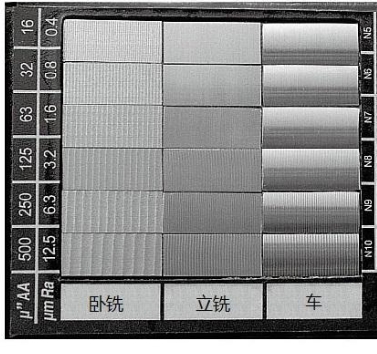
Different applications have different requirements for surface roughness. A lower surface roughness is specified only if there is a specific need. This is because a lower Ra value means more machining operations and stricter quality control are required, which will inevitably increase machining costs and time. As a result, post-processing operations are often not preferred in cases where a specific surface roughness is required, as these operations are difficult to precisely control and can adversely affect the dimensional tolerances of the part. 4. Comparison of surface roughness of CNC milling and turning In some applications, surface roughness can have a significant impact on the function, performance, and durability of a part. It is directly related to the coefficient of friction, noise level, wear, heat generation and adhesion of the part during use. The importance of these factors varies depending on the specific application. So, while the surface roughness of a part may not seem so critical in some cases, it plays a vital role in many other applications. These applications include, but are not limited to, high-tension, high-stress, and high-vibration environments, components that require precise fit and smooth movement, fast-rotating components, and medical implants. As mentioned earlier, different applications have different stringent requirements for surface roughness. Here's a look at the roughness levels offered by Xometry power, as well as everything you need to know to choose the right Ra value for your application -3.2 μm Ra This is a standard commercial machine finish. It is suitable for most consumer parts and is smooth enough, but contains noticeable cut marks. Unless otherwise specified, this surface roughness is applied by default. 3.2 μm Ra is the maximum surface roughness recommended for parts subjected to stress, load, and vibration. It can also be used for the fitting of moving surfaces when the load is light and the movement is slow. When machining, it is necessary to have high speed, fine feed, and light cutting. -1.6 μm Ra Typically, there will only be slight visible cut marks when using this option. This Ra value is recommended for tight fit and stressed parts, and is also sufficient for slow-moving and lightly loaded surfaces. However, it is not suitable for fast-rotating parts and violently vibrating parts. This surface roughness is produced under controlled conditions by high speed, fine feed and light cutting. -0.8 μm Ra This surface finish is considered to be of a high grade and requires very strict control when producing, so it is costly. Parts that need to be used for stress concentrations. It can be used for bearings when movement occurs occasionally and the load is light. -0.4 μm Ra This surface roughness reaches a finer level (called "less rough" in technical terms) and represents a very high-quality finish. It is particularly suitable for parts that are subjected to high tension or stress, as well as fast-moving components such as bearings and shafts. Because of the more tedious steps required to create this surface roughness, it is only used when smoothness is critical. |
|
|
Discover professional CNC machining services for precision metal and plastic parts, offering milling, turning, 5-axis machining, and advanced part manufacturing solutions tailored to your needs.
|


